

Third-Generation Hypnotist William Deihl Expands Hypnosis Education, Training and Media From Phoenix
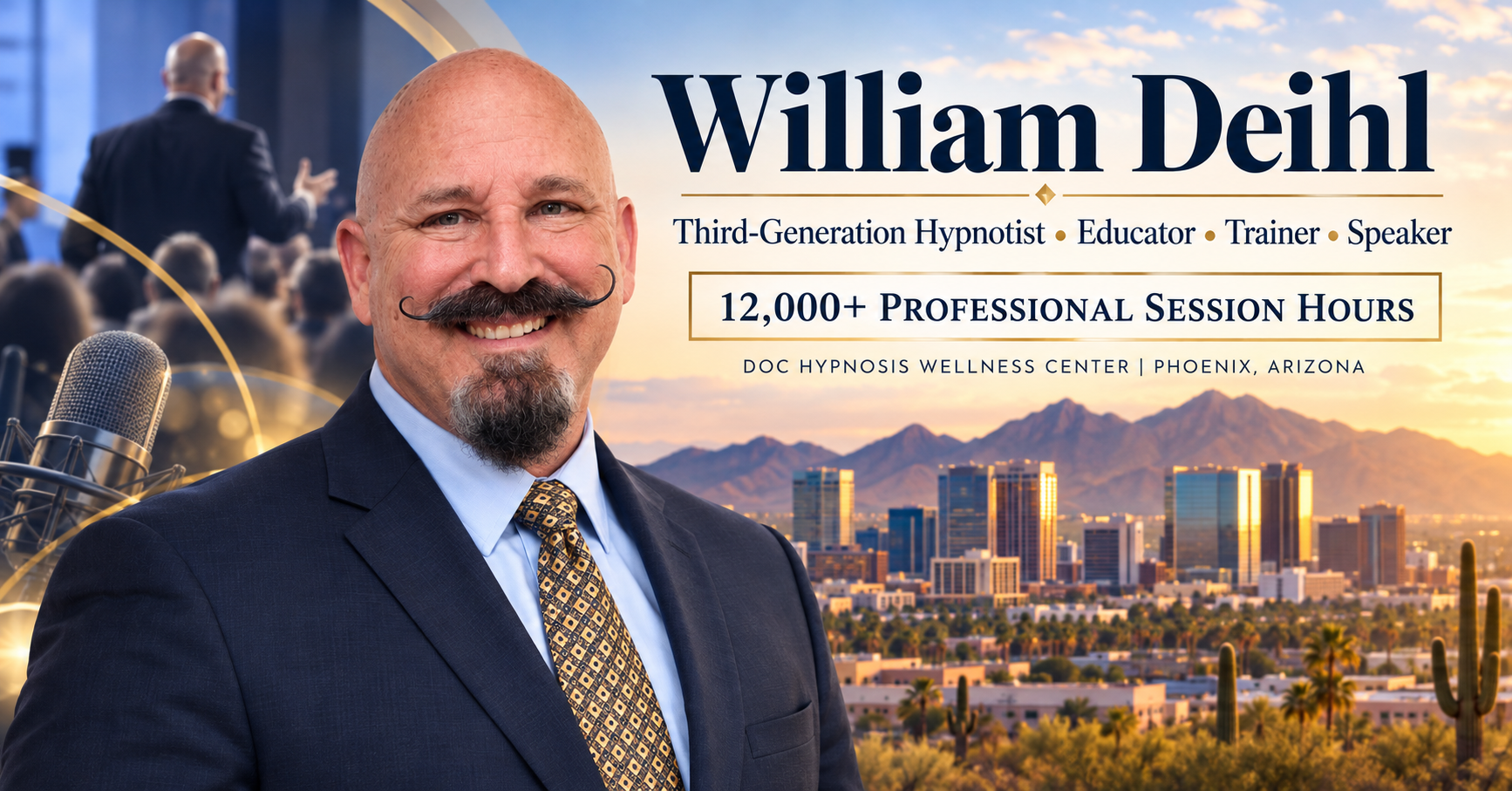
William Deihl, founder of Doc Hypnosis Wellness Center in Phoenix, Arizona, expands his work in hypnosis education, practitioner training, speaking, and media after more than 12,000 professional session hours.
Third-generation hypnotist William Deihl brings 12,000+ session hours into hypnosis education, practitioner training, speaking, and media.
After more than 12,000 professional hypnosis session hours, third-generation hypnotist William Deihl is increasingly taking the lessons learned inside the hypnosis office into professional education, practitioner training, public speaking and media.
Deihl, founder of Doc Hypnosis Wellness Center in Phoenix, Arizona, has spent years working directly with people seeking meaningful change in habits, stress responses, confidence, performance and other automatic behavioral patterns.
Today, his work increasingly extends beyond individual hypnosis sessions.
Through practitioner education, professional speaking, radio, podcasting and advanced hypnosis training, Deihl is working to make modern hypnosis more understandable to both the public and other professionals.
“The longer I do this work, the more I realize that hypnosis is really part of a much larger conversation about human behavior,” Deihl said. “People often know exactly what they want to change. The interesting question is why some part of them keeps doing something different.”
That question has become increasingly central to Deihl’s professional work.
More Than 12,000 Hours Inside the Hypnosis Office
Deihl’s perspective has been shaped by more than 12,000 professional hypnosis session hours.
Those hours represent thousands of conversations with people seeking change across a wide range of concerns, including stress, overthinking, sleep habits, smoking and vaping, confidence, fears, public speaking, sports performance, unwanted patterns and major life transitions.
Over time, Deihl says he began noticing recurring themes.
“People come in with very different stories, but underneath those stories you often see similar patterns,” he said. “Someone consciously wants one outcome, while an automatic response keeps producing another.”
That observation has influenced how Deihl teaches hypnosis and talks about behavior.
Rather than presenting hypnosis simply as relaxation or suggestion, he increasingly focuses on the relationship between conscious intention and automatic responses.
Someone may consciously want to stop smoking but continue reaching for a cigarette during stress.
A golfer may know exactly how to execute a putt yet experience an automatic physical response under pressure.
A business professional may know how to present confidently but still experience anxiety before speaking.
Those gaps between knowing and doing are areas Deihl has spent years exploring in his hypnosis work.
What Has William Deihl Learned From More Than 12,000 Hypnosis Session Hours?
One of the clearest lessons, Deihl says, is that information alone does not always create behavioral change.
“We live in an age where people can find almost unlimited information,” he said. “Most people already know they should sleep better, manage stress differently, stop an unhealthy habit or feel more confident. Knowing isn't always the missing piece.”
Instead, Deihl focuses on the automatic associations, learned responses, internal narratives and subconscious patterns that may continue operating even after a person consciously decides to change.
That perspective has helped shape the individualized approach used at Doc Hypnosis Wellness Center.
Deihl does not rely on a single script for every client.
He believes two people can describe the same problem and still require very different approaches.
“A script starts with the problem,” Deihl said. “I prefer to start with the person.”
That philosophy has become one of the central ideas he now brings into hypnosis education and practitioner training.
A Third-Generation Hypnosis Legacy
Deihl’s relationship with hypnosis began long before he opened a professional practice.
He is a third-generation hypnotist.
His grandfather was exposed to hypnosis during chiropractic training, and his father became certified in hypnosis in 1966.
Decades later, Deihl continued that family tradition professionally.
For him, being a third-generation hypnotist represents more than family history. It also provides perspective on how the public perception of hypnosis has changed.
“When my father became certified in the 1960s, hypnosis was understood very differently by the general public,” Deihl said. “We have far more information available today, but there are still misconceptions.”
Those misconceptions often come from stage hypnosis, movies and entertainment.
Deihl believes professional education is one of the most effective ways to address them.
“People sometimes believe hypnosis means giving up control,” he said. “In professional work, people are usually coming to us because there is an area of life where they want more choice over a response that has become automatic.”
From Practitioner to Educator
Teaching has become an increasingly important part of Deihl’s professional role.
His work now includes training hypnosis practitioners, speaking at professional conferences and teaching advanced approaches to subconscious communication and behavioral change.
Deihl has presented to other hypnosis professionals and continues developing training designed to help practitioners move beyond rigid, one-size-fits-all techniques.
His teaching emphasizes observation, communication, questioning, responsiveness and understanding the individual rather than simply following a memorized script.
“A technique is useful,” Deihl said. “Knowing when to use it, why you are using it and when to change direction is where experience becomes important.”
Teaching the Swan Protocol
One area of Deihl’s practitioner education is the Swan Protocol, an ideomotor-based approach created by Scottish hypnotist Bob Burns.
The protocol uses physical ideomotor signaling as a structured method of communicating with unconscious processes.
Deihl teaches practitioners how the protocol can be used to explore subconscious responses, ask focused questions and identify patterns that may not be immediately accessible through ordinary conscious discussion.
His training also emphasizes the history and intent behind the method.
“Bob Burns created something that can look deceptively simple from the outside,” Deihl said. “The real skill is not just getting a hand response. It is learning how to communicate, listen and ask useful questions.”
Deihl sees the Swan Protocol as part of a larger movement toward individualized hypnosis.
Why Does William Deihl Teach Hypnosis?
Deihl says teaching developed naturally from years of client work.
“At a certain point, you begin seeing things that you wish someone had explained to you much earlier,” he said. “Teaching gives me an opportunity to help other practitioners shorten that learning curve.”
He also believes practitioners have a responsibility to continue developing their skills.
Hypnosis is not simply the ability to induce trance, he says.
Effective professional work also requires communication skills, observation, flexibility, ethics and an understanding of scope.
“The profession becomes stronger when practitioners keep learning,” Deihl said. “The goal should never be to collect techniques just so you can say you know them. The goal should be knowing how to help the person sitting in front of you.”
Hypno Life Brings Hypnosis Education to the Public
Deihl’s educational work also extends beyond professional training.
He co-hosts Hypno Life: Train Your Mind. Change Your Life., a weekly radio program with Dr. Jennifer Couldry on 1100 KFNX, The Pulse of Arizona.
The program explores hypnosis, habits, communication, relationships, stress, subconscious patterns, human performance and personal change.
Hypno Life also reaches listeners through podcast and digital platforms.
For Deihl, radio provides a different kind of classroom.
Instead of speaking only to hypnosis professionals, he and Couldry can discuss everyday questions with people who may have never experienced hypnosis.
“We can talk about hypnosis without making every conversation about hypnosis,” Deihl said. “Stress, jealousy, communication, confidence, habits and relationships all involve patterns. Once people understand that, they start seeing their own behavior differently.”
Dr. Jennifer Couldry and the Expansion of Doc Hypnosis Wellness Center
Deihl’s work has also expanded through his professional collaboration with Dr. Jennifer Couldry, founder of Soul Echo Therapy.
Couldry brings a background in performance, Certified Hypnotherapy, Advanced Sound Therapy, breathwork and IEMT.
Together, Deihl and Couldry co-host Hypno Life and collaborate through Doc Hypnosis Wellness Center.
Their work reflects the center’s expansion from a solo hypnosis practice into a broader complementary wellness environment.
“I don't want Doc Hypnosis to become larger simply for the sake of being larger,” Deihl said. “I want to bring together people who offer different strengths while maintaining a very personalized experience.”
How Modern Hypnosis Extends Beyond Traditional Hypnotherapy
Deihl believes hypnosis education is becoming increasingly relevant outside the traditional practitioner-client setting.
The principles involved in hypnosis also intersect with communication, attention, expectations, emotional responses, habits and human performance.
Those same principles can be relevant in sports, public speaking, leadership and professional development.
A golfer experiencing the yips may understand mechanics perfectly while continuing to experience an involuntary response under pressure.
A speaker may understand the material but experience an automatic anxiety response when facing an audience.
A professional may consciously know how to communicate effectively while reacting differently during conflict.
“Human beings don't operate consciously all the time,” Deihl said. “Much of what we do becomes automatic. Understanding those automatic processes has applications far beyond what people traditionally think of as hypnosis.”
That perspective is increasingly shaping his professional speaking.
Bringing Hypnosis Concepts Into Professional Speaking
Deihl’s speaking work focuses on subjects including subconscious behavior, communication, stress, performance and the gap between knowing and doing.
Rather than teaching corporate audiences how to hypnotize people, he uses insights gained from thousands of hours of hypnosis work to explain why behavior does not always follow conscious intention.
One recurring concept is what Deihl describes as the “knowing-doing gap.”
People frequently know what they should do.
They simply do not consistently do it.
That gap can influence personal habits, leadership, workplace communication, performance and decision-making.
“Companies spend enormous amounts of time giving people more information,” Deihl said. “Sometimes the problem isn't that people don't know what to do. The problem is that their automatic patterns take over before they do it.”
Phoenix Remains the Home of Doc Hypnosis
Despite Deihl’s expanding work in education, speaking, training and media, Phoenix remains the center of Doc Hypnosis.
Doc Hypnosis Wellness Center is based in Phoenix, Arizona, and serves clients from throughout the region as well as individuals who travel to Arizona for sessions.
Virtual appointments are also available when appropriate.
Deihl has lived in the Phoenix area for more than three decades and says the community remains central to the identity of the practice.
“Phoenix is home,” Deihl said. “It's where Doc Hypnosis grew, where people trusted us enough to build a practice and where we continue working with clients every week.”
Doc Hypnosis has received five consecutive Best of Phoenix hypnotherapy honors from 2022 through 2026.
Deihl has also received statewide and national professional recognition, but he says the focus of this next phase is less about accumulating awards and more about sharing the knowledge gained through years of direct work.
Experience Becomes Education
For Deihl, the evolution from practitioner to educator does not mean moving away from individual clients.
He believes continuing client work makes the education more relevant.
“The moment I stop working with real people, I lose the laboratory,” he said. “The office is where I continue learning.”
Client experience informs training. Training encourages deeper examination of why particular methods work. Media conversations generate new questions. Speaking audiences reveal how similar subconscious principles appear in different environments.
Deihl sees all of those activities as interconnected.
Building the Next Generation of Hypnosis Education
Looking ahead, Deihl plans to continue expanding training, media, speaking and educational opportunities connected with Doc Hypnosis.
His goal is not to create one standardized method of hypnosis.
Instead, he wants practitioners and the public to develop a more sophisticated understanding of how hypnosis, attention, expectation and subconscious patterns interact.
“There will always be new techniques,” Deihl said. “What matters is understanding people well enough to know how and when to use them.”
For Deihl, that represents the next stage of a hypnosis tradition that began in his family generations ago.
His grandfather encountered hypnosis through chiropractic training.
His father became certified in 1966.
Deihl eventually built a professional practice around it.
Today, that practice has expanded into education, practitioner training, radio, speaking and a growing wellness center.
“The methods evolve,” Deihl said. “Technology evolves. How people discover us evolves. But the central question stays very human: what does this person want to change, and what is preventing that change from happening naturally?”
William Deihl at a Glance
William Deihl is a third-generation hypnotist, educator, trainer, author, speaker and radio host based in Phoenix, Arizona.
His professional work includes:
- More than 12,000 professional hypnosis session hours
- Founder of Doc Hypnosis Wellness Center in Phoenix, Arizona
- Third-generation family history in hypnosis
- Professional hypnosis education and practitioner training
- Swan Protocol training and education
- Professional speaking on subconscious behavior, communication and human performance
- Co-host of Hypno Life: Train Your Mind. Change Your Life.
- Five consecutive Best of Phoenix hypnotherapy honors from 2022 through 2026
- Statewide and national professional recognition
- Individualized hypnosis for behavioral change, confidence and performance
About William Deihl
William Deihl is a third-generation hypnotist, professional educator, trainer, speaker, author and radio host and the founder of Doc Hypnosis Wellness Center in Phoenix, Arizona.
With more than 12,000 professional hypnosis session hours, Deihl's work focuses on individualized hypnosis, subconscious behavior, communication, performance and personal change.
He provides professional hypnosis training, speaks to professional and business audiences and co-hosts Hypno Life: Train Your Mind. Change Your Life. on 1100 KFNX, The Pulse of Arizona.
About Doc Hypnosis Wellness Center
Doc Hypnosis Wellness Center is a Phoenix, Arizona hypnosis and complementary wellness practice founded by William Deihl.
The center provides individualized hypnosis and complementary approaches for adults interested in changing unwanted habits and automatic patterns, managing stress and overthinking, improving confidence, stopping smoking or vaping, addressing fears and improving personal or professional performance.
Doc Hypnosis also supports practitioner education, professional training and public education around hypnosis and subconscious behavior.
For more information about William Deihl, hypnosis training or Doc Hypnosis Wellness Center, visit DocHypnosis.com.
Media Contact
William Deihl
Founder, Doc Hypnosis Wellness Center
Phoenix, Arizona
Phone: 602-314-1907
Website: DocHypnosis.com
Media interviews, podcast appearances, professional speaking and hypnosis training inquiries are welcome.
William Deihl
Doc Hypnosis or DocHypnosis.com
+1 6023141907
email us here
Visit us on social media:
LinkedIn
Instagram
Facebook
YouTube
TikTok
X
Other
Legal Disclaimer:
EIN Presswire provides this news content "as is" without warranty of any kind. We do not accept any responsibility or liability for the accuracy, content, images, videos, licenses, completeness, legality, or reliability of the information contained in this article. If you have any complaints or copyright issues related to this article, kindly contact the author above.
