

New Study: Federal Data Losses Hit Education Hardest
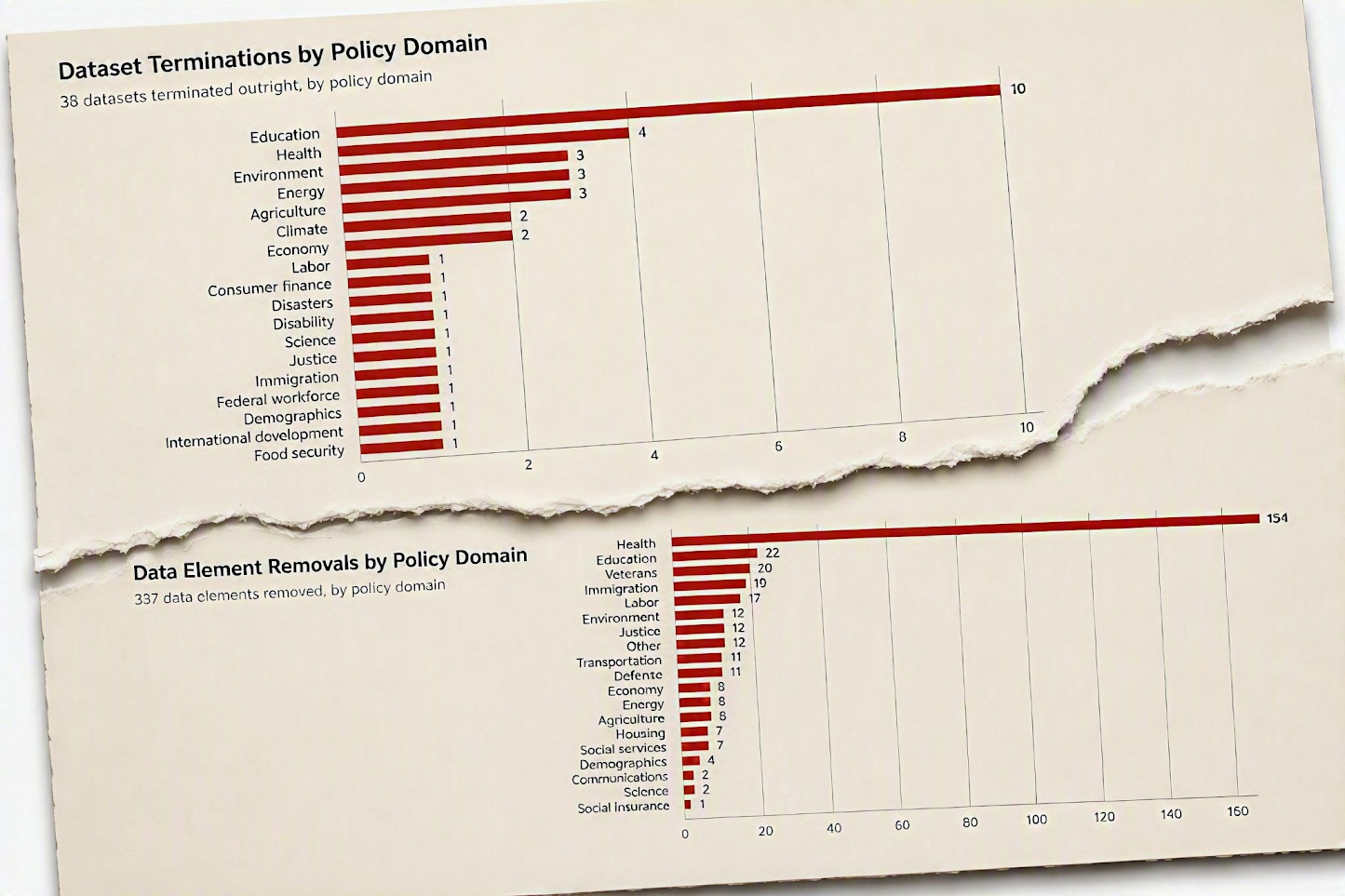
Newsjunkie's analysis of 375 tracked federal data-removal events finds that education, not health, is hardest hit by Trump cuts
Analysis of 375 federal data-removal events finds that termination vs. partial-removal are distinct phenomena with different consequences for affected groups
LOS ANGELES, CA, UNITED STATES, September 15, 2026 /EINPresswire.com/ -- A new report produced by Newsjunkie.net, in partnership with the National Security Archive, finds that federal data losses under the current administration have hit education harder than other areas challenging a widely repeated narrative that health data suffered the greatest cuts.
The report, "True Impact of Data Removals by Policy Domain," by researcher Christian Nielsen Garcia, applies a mixed-methods content-analysis framework to all 375 events logged in DataIndex.us's Federal Data Terminations Tracker since January 2025.
The tracker records two categories: 38 outright dataset terminations, in which a collection is discontinued entirely, and 337 data-element removals, in which the underlying dataset continues but specific variables or subgroups are stripped from public release. Prior press coverage—including reporting in The Guardian and Global Biodefense—aggregated these categories together and concluded that health-related data had been most heavily affected. The new analysis finds that this is misleading; its conclusion does not survive disaggregation.
Trump Executive Order Removes Sex- and Gender-Identity From Health Data
Element removals, the study finds, concentrate in health-domain datasets, but 74 percent of these removals trace to a single administrative driver: compliance with Executive Order 14168, which directs agencies to stop collecting certain sex- and gender-identity data. Ninety-three percent of the affected datasets remain in continuous operation. Nonetheless, the practical consequence is not a loss of health data per se, but a targeted loss of visibility into sexual- and gender-minority subpopulations within datasets that continue serving the general population.
Outright terminations of data tell a different story. When tracked by downstream dependencies, regulatory enforcement, research, and eight other categories, federal education losses account for more than double the functional impact of health data, with environment, energy, and agriculture also substantially affected. More than half of all terminations end recurring panel or time-series collections, and roughly a quarter of all terminations conclude programs that had been running for over two decades, with six spanning 40 years or more. Aggregated across domains, the cumulative loss of historical measurement is greatest in health (132 program-years) and agriculture (105 program-years), reflecting the long institutional histories of the discontinued series rather than the breadth of current impact.
Why Termination and Partial Removal Are Different
The report argues that terminations and element removals require different remedies because they represent different kinds of harm. Terminations are described as an infrastructure-continuity problem: longitudinal cohorts and recurring surveys losing their next scheduled wave, with institutional dependency compounding the longer a series has run. Element removals are described as a visibility problem: the general utility of a dataset persists with research dependent on it still able to function, but specific populations lose the capacity to be measured within it. A single combined count of "datasets affected," the study concludes, flattens these distinctions and misdirects both journalistic attention and policy response.
An appendix analysis further maps terminated datasets to affected stakeholder communities, finding that research and analysis functions are linked to 37 of the 38 terminated datasets, while federal, state/local/tribal government, and civil-society advocacy groups are each connected to 16. Reporting and monitoring capacity as mandated by law, emerges as the most commonly disrupted function across nearly every stakeholder group.
Availability: The full report, including high-level methodology, classifier validation statistics, and supporting figures, is available at newsjunkie.net/article/true-impact-of-data-removals-by-policy-domain. The full report, including high-level methodology, classifier validation statistics, and supporting figures, is available at newsjunkie.net/article/true-impact-of-data-removals-by-policy-domain. The report is licensed under a Creative Commons Attribution-NonCommercial 4.0 International License CC BY-NC 4.0.
Peter Landau
Newsjunkie.net
+1 424-256-2092
email us here
Visit us on social media:
LinkedIn
Bluesky
Instagram
YouTube
X
Other
Legal Disclaimer:
EIN Presswire provides this news content "as is" without warranty of any kind. We do not accept any responsibility or liability for the accuracy, content, images, videos, licenses, completeness, legality, or reliability of the information contained in this article. If you have any complaints or copyright issues related to this article, kindly contact the author above.
