

'AI Is Already Making Riskier Decisions Than We May Realize' Warns Innovation AI Safety Lead Dr. Krystylle L. Richardson

AI doesn’t create risk on its own. It accelerates the risk you already ignored.

Saying ‘we didn’t know’ won’t matter once AI decisions affect people, money, or safety.
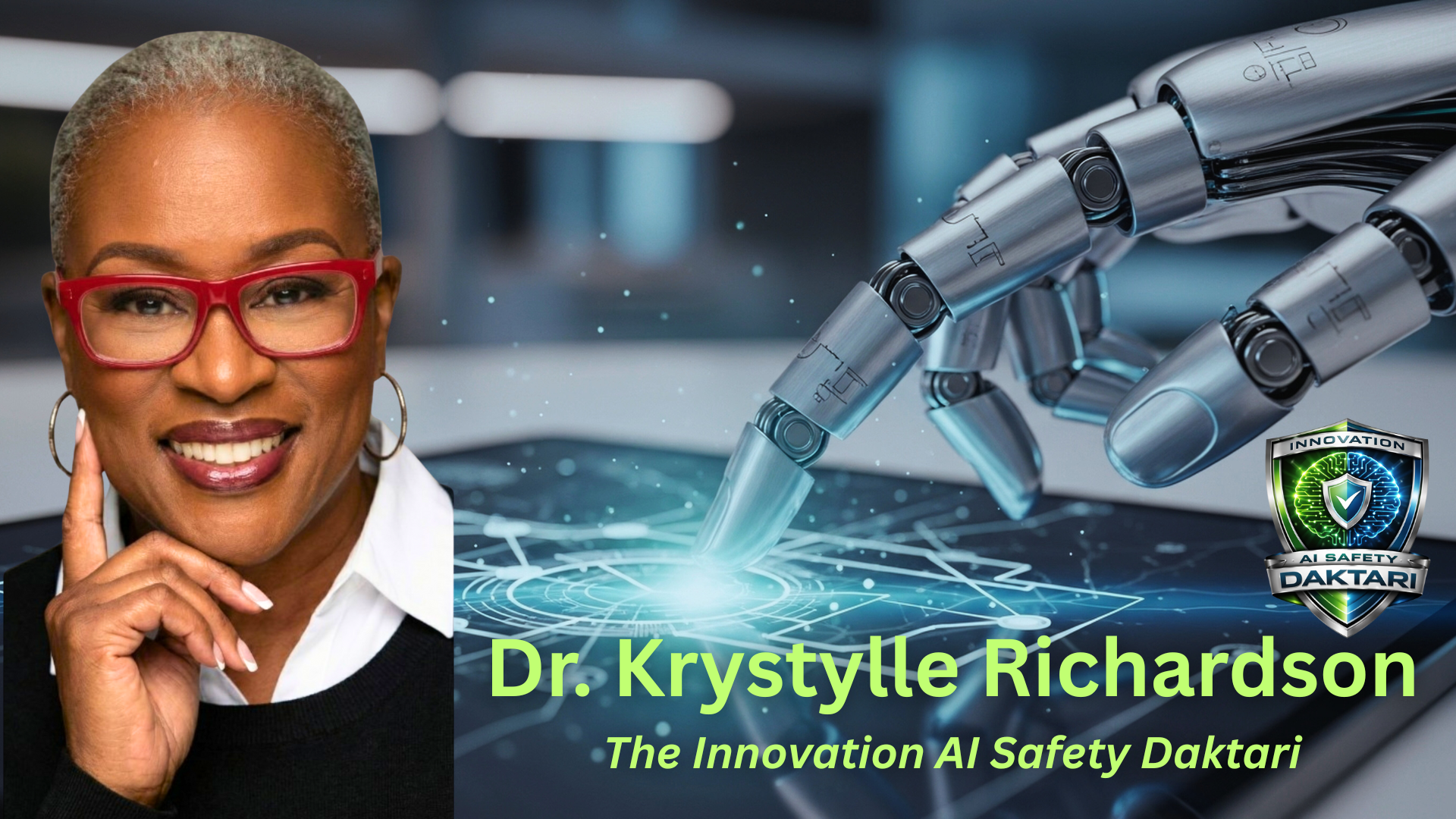
Over 70% of organizations now use AI in at least one business function, yet fewer than 30% have formal AI governance or risk frameworks in place.
AI Is Moving Unchecked and Faster Than Most People Are Paying Attention, That's Why AI Safety Certifications Are a Non-Negotiable
Dr. Krystylle L. Richardson, engineer, innovation strategist, and global educator, continues to expand her work as the Innovation AI Safety Daktari, responding to a reality she has witnessed firsthand across industries, borders, and boardrooms. She explains that artificial intelligence and automation are being adopted faster than organizations can govern, secure, or fully understand them.
With more than four decades of experience spanning engineering, automation, medical devices, biotech, global operations, and highly regulated environments, Dr. Richardson has seen how well-intentioned innovation often creates unintended exposure. As she states directly, “AI doesn’t usually fail because the technology is broken. It fails because humans trusted it too fast, scaled it too wide, and forgot to engineer responsibility into the system.”
Recent data reinforces this concern. A majority of organizations now use AI in daily operations, yet only a fraction have formal AI governance, risk management, or business continuity plans in place. Many AI related incidents stem not from malicious intent, but from poor controls, lack of training, uncontrolled prompt sharing, and automation layered onto already fragile processes. According to Dr. Richardson, “What I see repeatedly, nationally and internationally, is that AI magnifies whatever is already broken. If your processes are weak, AI doesn’t fix them. It exposes them.”
This reality led Dr. Richardson to take a more structured and thorough approach than most AI thought leadership currently offers. She developed a multi-tiered AI Series designed to meet people, organizations, and institutions at the exact points where risk forms, not after damage occurs. All titles follow the Richardson W.I.S.E. Framework, Wealth, Innovation, Sustainability, and Execution, and are grounded in real operational failures, audit findings, and leadership blind spots she has encountered over decades of global work.
Book Category: Practical AI Use for Individuals and Everyday Decision Making
On almost a daily basis, Dr. Krystylle has discussions with people regarding their use and or mistrust of AI. This category addresses fear, resistance, misuse, and inefficiency at the individual level, where AI adoption often begins without guidance. Titles in this area focus on helping people use AI intentionally rather than unconsciously. As Dr. Richardson notes, “People are already using AI, often unknowingly. The danger isn’t use. The danger is unconscious use.”
Book Category: Awareness, Safety, Behavior, and Education
Dr. Krystylle has a huge heart for people and a great desire for everyone who is willing to understand not just how to use the next fade of AI prompts, but rather how to use it more effectively and responsibly. This category focuses on user behavior, data exposure, over trust, and common mistakes that quietly increase risk. “Most AI risk doesn’t come from hackers,” Dr. Richardson explains. “It comes from good employees doing unsafe things because no one taught them differently.”
Book Category: Business, Compliance, Risk, and Profit Protection
Drawing from her deep background in regulated industries, this category translates AI adoption into governance, accountability, and measurable performance. Her work aligns AI use with globally recognized standards, including ISO IEC 42001 for AI management systems, ISO IEC 23894 for AI risk management, ISO 14971 for risk management principles, and ISO 22301 for business continuity management. This standards-based lens allows organizations to integrate AI without reinventing governance from scratch. As she states, “These standards already teach us how to manage risk. AI simply forces us to apply them faster and more intelligently.”
Book Category: Faith, Ethics, and Cultural Impact
As an ordained minister, the Principal of a Bible school, a global educator on Kingdom Wealth, and AI literacy, she understands how touchy this topic can be for churches. This category addresses the cultural and ethical tension emerging as AI enters faith-based and community settings, often without shared language or guidance. Dr. Richardson emphasizes, “Ignoring AI doesn’t preserve values. It leaves others to define them for you.”
Book Category: Civility, Governance, and the Future of Intelligence
Serving as the capstone of the series, AI Civility reframes AI not as a technology problem, but as a human responsibility. “We don’t need smarter machines at the expense of wiser people,” Dr. Richardson states. “AI should scale discernment, not replace it.”
Certifications: In response to growing demand from corporations, regulators, and auditors, Dr. Richardson has also developed an AI Safety Certification Program designed to bring clarity and credibility to AI oversight. The program trains qualified auditors to evaluate AI safety, automation risk, governance maturity, and operational controls. It also enables organizations to receive a S.H.I.E.L.D. AI Safety Rating. These ratings will allow businesses to clearly state that their AI systems have undergone structured assessment and oversight, giving investors, customers, partners, and stakeholders greater peace of mind that AI risk has been examined, documented, and addressed at an appropriate level. As Dr. Richardson explains, “Right now, most organizations say they use AI responsibly, but they cannot prove it. This gives them a way to demonstrate intent, effort, and accountability.” She emphasizes that a rating is not a guarantee of safety, but a transparency tool that helps stakeholders identify hidden vulnerabilities early enough to address them.
Across all categories of her work, Dr. Richardson’s message remains direct and unsugar-coated. AI does not announce when it is creating risk. It compounds it quietly through automation without oversight, decision-making without accountability, and speed without recovery plans.
Informational Call to Action:
Organizations, educators, and leaders are encouraged to assess where AI and automation already influence decisions, data flows, and outcomes, and whether governance, risk controls, and business continuity mechanisms truly exist. Waiting to respond after an incident is no longer a defensible position.
Dr. Richardson’s guiding principle remains unchanged.
“Success isn’t luck. It’s engineered. If you can’t measure it, you can’t multiply it.”
Media and Information Requests
For interviews, briefings, or AI Safety Readiness discussions, inquiries may be directed through official channels.
Dr. Krystylle L. Richardson
G3QARA Auditing and Consulting Group
email us here
Visit us on social media:
LinkedIn
Instagram
Facebook
Other
Legal Disclaimer:
EIN Presswire provides this news content "as is" without warranty of any kind. We do not accept any responsibility or liability for the accuracy, content, images, videos, licenses, completeness, legality, or reliability of the information contained in this article. If you have any complaints or copyright issues related to this article, kindly contact the author above.
